
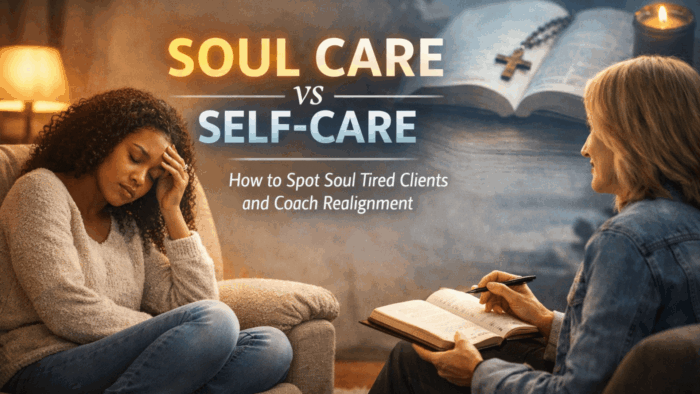
How can Christian coaches tell the difference between burnout and spiritual drift?
Your client is doing the work. She is setting limits, sleeping more, taking time off. She comes to sessions prepared and she is trying. And she still sits across from you and says, I do not know why, but I still feel off.
You probably already sense what is happening. This may not be a self-care problem. This could be a soul care problem.
As a Holy Spirit-led coach, you are uniquely positioned to help your clients make this distinction. But it starts with being clear on it yourself, and having a practical way to bring it into your coaching conversations without overcomplicating what is already a full session.
This post breaks down the difference between self-care and soul care, explains why it matters in your coaching practice, and gives you a ready-to-use next step for your clients.
The Self-Care Ceiling Your Clients Keep Hitting
Self-care is good and necessary. God designed rest, limits, and Sabbath into creation itself. Helping your clients honor their bodies and protect their energy is part of sound coaching. The problem is not self-care.
The problem is when self-care becomes the only response to what is actually a soul care need.
Your clients can do all the right things and still feel spiritually empty. They can get enough sleep, set healthy limits, go to therapy, eat well, and still show up to their calling feeling hollow. That is the self-care ceiling. And most of them do not have language for it yet.
That is where you come in.
“He restores my soul. He leads me in paths of righteousness for his name’s sake.” — Psalm 23:3 ESV
Soul restoration is God’s work. Your role as a coach is to help your clients recognize when they need the Shepherd, not just better strategies, and to create the space for that to happen.
The Distinction Your Coaching Conversations Need
Self-care asks: what do I need to feel better?
Soul Care asks: what does my soul need to stay aligned with God?
That is not a small difference. It is the difference between a client who recovers and a client who is genuinely transformed.
Here is how to think about it in your coaching context:
| Self-Care | Soul Care | |
| Main Goal | Restore capacity: energy, mood, health | Restore communion: closeness, obedience, peace |
| Best For | Stress, burnout, emotional load | Drifting, numbness, cynicism, off seasons |
| Common Practices | Sleep, limits, counseling, movement | Prayer, Scripture, Sabbath, repentance, solitude |
| Warning Sign | Turns into numbing or avoidance | Turns into performance or checking boxes |
| Ultimate Question | What will help me feel better? | What does God want to heal or realign in me? |
Both are needed. The key is which one is leading. Soul care should anchor your clients’ self-care, not the other way around.
Five Soul Care Pillars to Bring Into Your Coaching
These are not just concepts to teach. They are coaching conversation starters. Each one opens a door your clients may not have known was there.
-
Repentance and Surrender
Many of your clients are carrying what God never asked them to carry. The quiet exhaustion of self-reliance is one of the most common presenting issues in Christian coaching, and it often looks like high performance on the outside and depletion on the inside.
Coach them toward the practice of regular surrender. Not as a one-time event but as a returning. Help them name what they have been clutching and create space to lay it down.
-
Sabbath as Worship, Not Just Rest
Many clients practice recovery. Very few practice Sabbath. Help them understand the difference. Recovery stops so you can perform again. Sabbath declares, God, I trust You enough to stop.
“Remember the Sabbath day, to keep it holy.” — Exodus 20:8 ESV
-
Communion Over Comfort
Self-care often aims for comfort. Soul care aims for communion. Coach your clients to notice when they are reaching for relief versus reaching for God. That distinction, once named, tends to shift a lot in their inner life.
-
Solitude and Silence
Jesus withdrew regularly to protect His alignment with the Father (Luke 5:16). Your clients need this too, especially the ones who are always pouring out. Build it into their Soul Care flow as a non-negotiable, not an afterthought.
-
Spiritual Community and Accountability
Soul care is not only private. Your clients need trusted people who speak truth to the condition of their soul. Part of your coaching work is helping them identify who those people are and whether they are actually letting them in.
Why This Matters for Your Coaching Practice
When your clients are stuck in self-care mode without soul care leading, your sessions can start to feel like you are helping them manage instead of transform. The work stays surface level. Progress stalls. And eventually, the client starts to wonder if coaching is even working.
You can teach what you know. But you reproduce who you are.
This is true for your clients and it is true for you. The condition of your own inner life is the foundation of your coaching effectiveness. A coach who is tending their soul brings something qualitatively different into a session than one who is simply well-rested.
When soul care leads in your life and in your coaching, something shifts. Your clients stop managing their exhaustion and start living from identity. They stop going through the motions of faith and start actually walking with God.
“Whoever believes in me, as the Scripture has said, ‘Out of his heart will flow rivers of living water.'” — John 7:38 ESV
Coaching Questions to Open the Conversation
Use these in a session when you sense your client has hit the self-care ceiling (Always keep your eyes open to hear the Holy Spirit):
- When was the last time you felt genuinely restored, not just rested?
- Is there something your soul has been trying to say that your schedule has not allowed you to hear?
- Where have you been seeking comfort when what you may actually need is communion with God?
- What would it look like to anchor your self-care in dependence on God rather than dependence on routine?
- What kind of tired are you carrying right now: physical tired, emotional tired, or soul tired?
Those questions are not filler. They are a doorway. They help your client move from “What can I do to feel better?” to “What is God restoring in me right now?”
And as a coach, you will feel the difference in the room when soul care leads. The session stops being a problem-solving loop and becomes a return to identity. Peace comes back online. Clarity follows.
If you want to guide that process without scrambling for language mid-session, I created a coach-ready workbook to support you.
A Ready-to-Use Tool for Your Clients
If this resonates with where your clients are, I put together a done-for-you resource you can use right away.
The Self-Care vs Soul Care Workbook: A Workbook for Restoration & Alignment is a 16-page, coach-ready tool that includes the Quick-Check Assessment, the Self-Care vs Soul Care comparison chart, a Weekly Soul Care Flow template, and Scripture-anchored teaching throughout and more. You can use it in one-on-one sessions, group coaching, or teach a workshop for your audience.
It is designed to do the heavy lifting so you can stay in your coaching lane while still taking your clients somewhere deeper.
Until then, keep coaching with eyes that see through the Holy Spirit.
Dr. Nanette Floyd Patterson, CPsy.D., LCMHC
Founder & Master HIScoach™